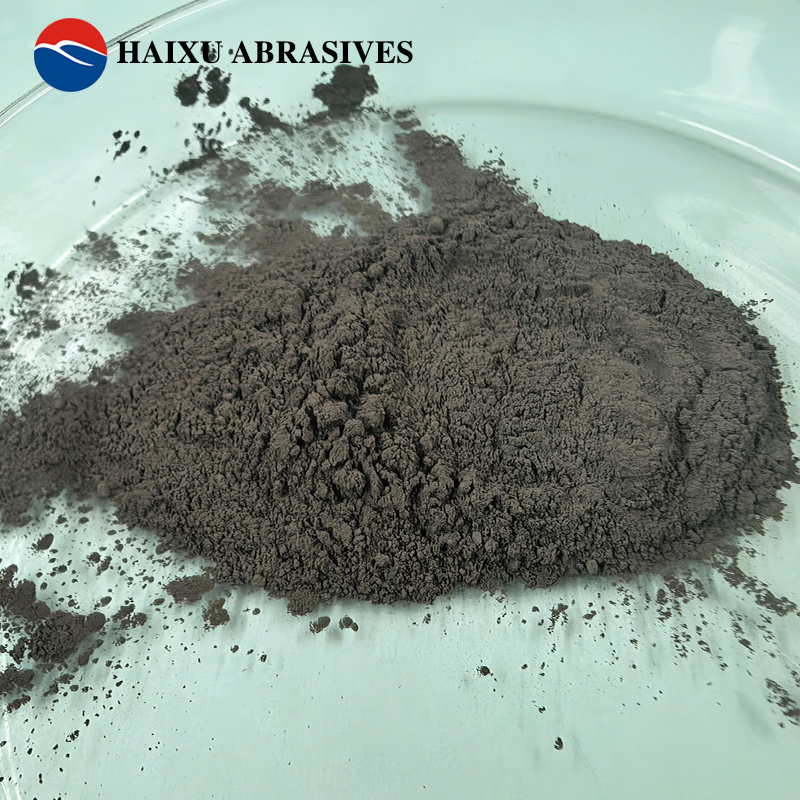
β-SiC powder 2-3μm for Electrostatic Chuck(ESC) silicon carbide ceramic
Beta-silicon carbide powder is also known as cubic silicon carbide (β-SiC or 3C-SiC). High purity 4N/5N β-SiC 2-3μm powder is suitable for manufacturing ceramic components such as ESC in semiconductor processing. An ESC is not a purely insulating ceramic. It requires a controlled semiconducting resistivity, uniform dielectric properties, resistance to plasma. The isotropic thermal and mechanical properties to ensure consistent wafer contact. There are fundamental differences between the β-SiC powder (cubic 3C-SiC) and the α-SiC (hexagonal 4H/6H-SiC) regarding sintering activity, electrical isotropy, and the controllability of doping.
1. Cubic structure ensures isotropic electrical, thermal, and mechanical properties
β-SiC possesses a cubic zinc-blende structure, which eliminates the crystallographic orientation dependence found in hexagonal α-SiC.
– In hexagonal α-SiC, electrical and thermal conductivity vary significantly depending on the crystal orientation. For an ESC, the entire surface must provide uniform electrostatic clamping force and a consistent rate of charge dissipation. Any local variation in clamping force can lead to wafer warpage, while uneven charge accumulation may cause electrical arcing.
– The cubic crystal system of β-SiC ensures that the dielectric constant, leakage current, and resistivity remain uniform across the plane, facilitating consistent clamping for both Coulombic-type and Johnsen-Rahbek (JR)-type electrostatic chucks. Research has demonstrated that using β-SiC-based powders makes it easier to achieve a relative standard deviation (RSD) of less than 5% for the clamping force across the entire wafer surface.
2. Higher sintering activity: Ultrafine powders facilitate near-full densification and a uniform, fine-grained microstructure
As a metastable phase, β-SiC contains a high density of intrinsic lattice defects and possesses a significantly higher surface energy than α-SiC. Sub-micron or nano-scale cubic silicon carbide powders offer a large specific surface area. It provides a strong driving force for diffusion during the sintering process. First, liquid-phase sintering (LPS-SiC) enables high densification and a fine-grained microstructure at lower temperatures. An ESC surface with a fine-grained structure exhibits superior flatness and fewer surface pores after polishing; this reduces particle contamination during plasma etching—a critical quality control parameter for ESCs used in etching equipment. Furthermore, beta phase transforms to alpha phase during the sintering process. This transformation allows for the regulation of grain growth and promotes the dissolution-precipitation of atoms within the liquid phase. Therefore, engineers can precisely control grain size and the distribution of grain-boundary phases.
Given the same sintering aids, β-SiC powder exhibits a higher dissolution rate, facilitating the formation of continuous and controllable conductive pathways. In contrast, α-SiC powder is more inert during sintering, requiring higher temperatures. It makes the powder more difficult to achieve a uniform, fine-grained microstructure.
3. A narrower bandgap and a broader doping window facilitate the precise control of the semiconductor resistivity required for ESCs.
– The bandgap of β-SiC is approximately 2.36 eV, compared to 3.0 eV for 6H-α-SiC and 3.2 eV for 4H-α-SiC.
– Nitrogen doping (substituting for carbon) in β-SiC results in a lower donor ionization energy (~60 meV, versus ~100–155 meV for 6H-α-SiC), making it easier to achieve stable and reproducible n-type semiconducting properties. ESCs typically operate within a resistivity range of 10⁸ ~ 10¹² Ω·cm ( JR type). This requires a small, controlled leakage current to dissipate residual charges. Thereby preventing the wafer from sticking to the chuck or shifting/jumping during the release process. When using β-SiC powder, dopants are distributed uniformly across the particle surfaces. That makes it easier to consistently hit the target resistivity range during mass production. Conversely, doping α-SiC is more challenging, and its resistivity is more prone to significant batch-to-batch variation.
4. Plasma Corrosion Resistance and Chemical Stability for Etching Chamber Environments
High-purity β-SiC features strong covalent bonds, resulting in significantly lower etch rates when exposed to fluorine-based (F-based) or chlorine-based (Cl-based) plasmas compared to Al₂O₃ or AlN.
In dense SiC ceramics fabricated from ultrafine β-SiC powder, the grain boundary phases can be engineered for corrosion resistance, ensuring the surface remains stable—resisting flaking or particle generation—even under repeated plasma exposure.
Furthermore, the coefficient of thermal expansion (CTE) of SiC is more closely matched to that of silicon wafers. This reduces thermal stress during thermal cycling, thereby minimizing wafer deformation and the risk of cracking in the electrostatic chuck (ESC). Notably, β-SiC is particularly well-suited for producing dense, fine-grained bodies with minimal porosity, which inherently lowers the rate of plasma-induced erosion at the microstructural level.
5. Advantages of Ultrafine Powders: Low Porosity, Mirror-Finish Polishability, and Uniform Conductive/Insulative Networks
The use of ultrafine β-SiC powders with 99.99% 99.999% SiC works in tandem with the β-crystalline phase to provide several benefits:
1. Small particle size and high packing density result in fine pores within the green body. It leads to an extremely low closed-pore ratio after sintering.
2. Grain refinement enables polishing to a nanometer-scale surface roughness. That ensures a tight fit with the wafer and improving the uniformity of the electrostatic clamping force.
3. The conductive percolation network becomes more uniform. It can eliminate the risk of electrical arcing or dielectric breakdown that could otherwise be caused by localized clusters of conductive material.
Industry Baseline: Commercial ESC formulations typically utilize high-purity β-SiC ultrafine powders (0.2–0.8 μm) combined with sintering aids such as Y-Al-O or Y-Si-C, processed via liquid-phase sintering in a nitrogen atmosphere.
6. Considerations for Practical Application
β-SiC is a metastable phase; prolonged exposure to temperatures above 1700 °C can trigger a phase transformation from β-SiC to α-SiC, accompanied by a slight change in volume. If the manufacturing process is not strictly controlled, this can lead to the formation of microcracks or structural deformation. Therefore, the sintering protocol for ESCs (electrostatic chucks) must be specifically designed for β-SiC powder. This involves controlling the degree of phase transformation—using the transformation itself to regulate grain structure—rather than attempting to suppress the phase transition entirely.
While α-SiC offers superior high-temperature stability and higher thermal conductivity, it suffers from low sintering activity and significant electrical anisotropy. Consequently, it is generally unsuitable for ESCs, which require uniform and controllable (albeit low) leakage currents; instead, α-SiC is typically reserved for components like susceptors or showerheads, where high thermal conductivity is the primary requirement.
In summary, the cubic phase of β-SiC provides isotropic electrical properties, lower activation energy for doping, and higher sintering activity. Using β-SiC fine powder enables the production of components with a fine-grained, highly dense microstructure and a polished surface with minimal defects. This allows for stable control over the ESC’s low-level leakage current and ensures uniform wafer clamping across the entire surface. Furthermore, it meets the rigorous demands of semiconductor etching chambers, including resistance to plasma erosion and low particle contamination. Due to its crystallographic anisotropy and the inherent difficulty in doping, α-SiC is not a suitable primary material for ESCs.