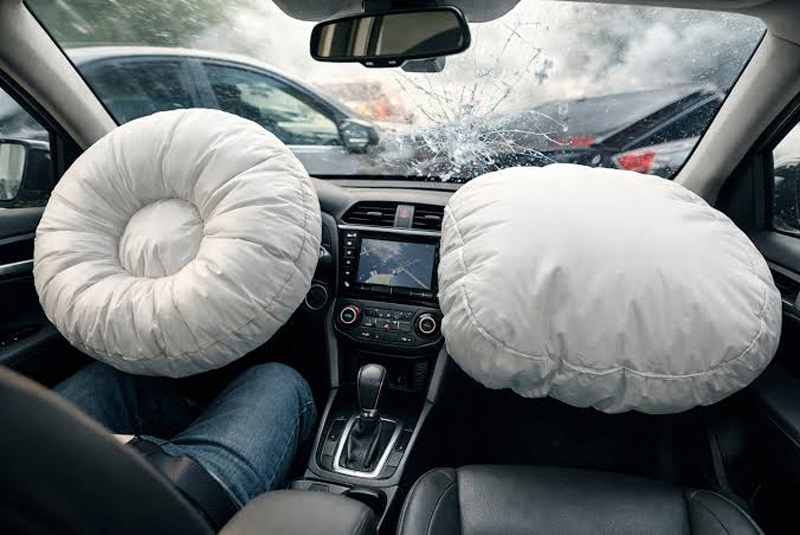
Amorphous Boron Powder for Automotive Airbag Igniter
Amorphous boron powder is a regular component in B/KNO₃ (boron/potassium nitrate) igniter compositions for automotive airbags. Non-crystalline Boron is the preferred form of fuel for this system in engineering applications. Amorphous B powder features long-range atomic disorder, a high density of dangling bonds, numerous surface defects, and a lower activation energy for reaction. That is the fundamental reason for its selection in airbag inflators.
The functions of amorphous boron powder in automotive airbag igniter compositions include the following:
1. Primary Fuel: Providing High-Quality Combustion Heat as an Energy Carrier
As the fuel in the system, amorphous boron reacts with oxygen supplied by potassium nitrate (a redox reaction). It can releas a significant amount of heat—typically around 2600–2700 J/g for standard formulations. The oxidation products include potassium metaborate, condensed-phase B₂O₃ particles, and a small quantity of gaseous products.
2. Reducing Ignition Activation Energy: Shortening Ignition Delay for Millisecond-Scale Rapid Response
Amorphous boron features a disordered arrangement of atoms and a high number of surface active sites. It possesses an apparent activation energy far lower than that of crystalline boron. For a given particle size, amorphous boron exhibits a significantly shorter ignition delay; it is more sensitive to the energy input from a bridgewire or exploding foil, facilitating the formation of “hot spots.” Automotive airbags require stable and rapid ignition across a broad temperature range (−40 °C to 85 °C) within an extremely tight temporal window (the entire airbag inflation process occurs in 20–30 ms). Amorphous boron is a critical component for achieving a low ignition threshold and minimal ignition delay.
3. Generation of a large volume of high-temperature condensed-phase particles, enhancing multi-mode ignition of the primary gas-generating propellant (GN/BCN—guanidine nitrate/basic copper nitrate)
The combustion products of B/KNO₃ consist primarily of high-temperature solid-phase particles rather than just hot gases. Amorphous boron undergoes more complete combustion, yielding a higher quantity of high-temperature B₂O₃ and KBO₂ particles. These facilitate the ignition of the primary gas-generating propellant through a combination of three mechanisms. Thermal conduction, Particle impact, and Thermal radiation. This directly improves ignition reliability under low-temperature conditions, preventing issues such as failure to ignite the primary propellant or delays in inflation.
4. Regulation of burning rate and pressure-rise rate to ensure combustion synchronization and pressure repeatability
The specific surface area, surface activity, and dispersion uniformity of amorphous boron directly dictate the burning rate and the slope of the pressure rise within the system. By controlling the particle size, purity, and surface oxide layer of the amorphous boron, the burning rate of the B/KNO₃ mixture can be stabilized within the range required for the generator’s internal pressure (7–50 MPa, with low pressure-dependence of the burning rate). This helps avoid two types of failure: excessive pressure-rise rates that could impact the housing, and overly slow burning rates that could cause a drift in ignition timing.
5. Good compatibility with KNO₃ and phenolic binders; long shelf life achieved through controlled oxidation
Pure amorphous boron is chemically inert at room temperature and does not react spontaneously with potassium nitrate (KNO₃) or phenolic binders. However, a drawback is its tendency to readily form a B₂O₃ oxide layer on its surface. During long-term exposure to heat and humidity, this oxide layer can absorb moisture, passivating the active boron. That leads to increased ignition delays and a reduction in total heat output.
Industry standard control measures include strictly regulating the thickness of the oxide layer on the amorphous boron and employing moisture-proof sealing for the propellant mixture, ensuring it meets the 10–15 year storage life requirement for automotive applications.
6. Matrix acts as a “hot spot” generator for absorbed excitation energy, enhancing ignition consistency
Amorphous boron exhibits a higher absorption rate for electrical and laser energy. Joule heating from the bridge wire preferentially creates “hot spots” on the surfaces of the amorphous boron particles, which subsequently trigger the decomposition of potassium nitrate (KNO₃). Amorphous boron-based systems offer high absorption across a broad laser wavelength spectrum and demonstrate lower variance in ignition thresholds. This makes them well-suited for in-line igniters—the standard ignition configuration used in automotive airbags.
Comparison for this application: Amorphous Boron vs. Crystalline Boron
Amorphous Boron Powder: Characterized by low ignition delay, complete combustion, and high condensed-phase heat output; ideal for rapid, wide-temperature-range ignition in airbags. Drawbacks include a tendency for surface oxidation and sensitivity to humidity.
Crystalline Boron Powder: Features a stable crystal lattice and high activation energy, resulting in longer ignition delays, incomplete combustion, and lower energy efficiency. It is generally not used in commercial airbag BKNO₃ ignition compositions.