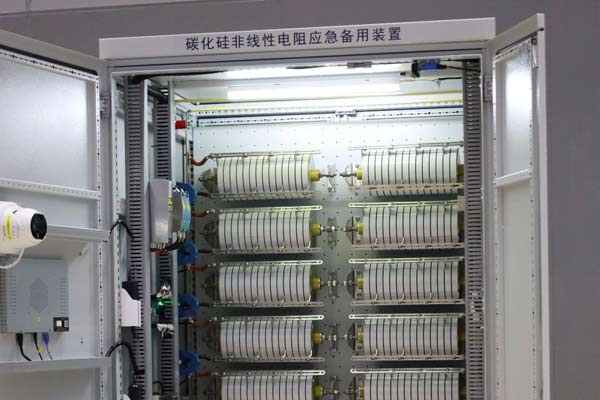
Water washed black silicon carbide F100 for semiconductor silicon carbide resistor
Water Wash black silicon carbide F100 is a fine silicon carbide sand produced through high-temperature smelting, crushing, acid and alkali washing, and graded purification. It meets the requirements of semiconductor silicon carbide resistor valves (varistors/magnetizing resistors). There are several advantages: high purity and low impurities, controllable electrical properties, strong thermal stability, dense structure, and weather resistance and durability.
I. High Purity and Low Impurities, Stable Electrical Performance
– High Purity. After water washing and purification, SiC content ≥99%, free carbon (F.C) ≤0.2%, iron oxide (Fe₂O₃) ≤0.4%, and extremely low metallic impurities.
– Low Impurity and Controlled Electrical Properties. A large amount of magnetic impurities such as iron and aluminum are removed, reducing leakage current and avoiding localized electrochemical corrosion. The valve’s nonlinear resistance characteristics are more stable, with lower residual voltage and faster response.
– Batch Consistency. Water washing and grading processes ensure concentrated particle size (125–150μm), clean particles without agglomeration. That results in low resistivity dispersion and strong batch consistency.
II. Controllable Semiconductor Characteristics, Excellent Varistor Response
– Wide Bandgap Semiconductor. Black silicon carbide inherently possesses nonlinear varistor characteristics; resistance decreases rapidly upon sudden changes in the electric field, accurately absorbing surges and providing reliable overvoltage protection.
– 100# Particle Size Adaptability. Coarse particles (125–150μm) form a stable conductive network, balancing valve conduction capacity and withstand voltage rating, suitable for medium and high voltage resistance valve molding.
– Adjustable Resistivity. Controllable purity and particle size allow for adjustable valve resistivity (10¹~10⁵Ω·cm), adapting to protection devices of different voltage levels.
III. High Thermal Conductivity + High Temperature Stability, Strong Heat Dissipation and Temperature Resistance
– High Thermal Conductivity. Thermal conductivity approximately 490 W/(m·K) (3 times that of silicon, 1.5 times that of copper), rapidly dissipating surge current heat, preventing valve plate thermal breakdown and extending service life.
– High Temperature Resistance. Melting point 2250℃, long-term operating temperature up to 1900℃, electrical/mechanical properties do not degrade at high temperatures, suitable for high-temperature, high-frequency applications.
– Low Thermal Expansion. Low coefficient of thermal expansion, less prone to cracking and deformation under temperature differences, stable valve plate structure, and strong thermal shock resistance.