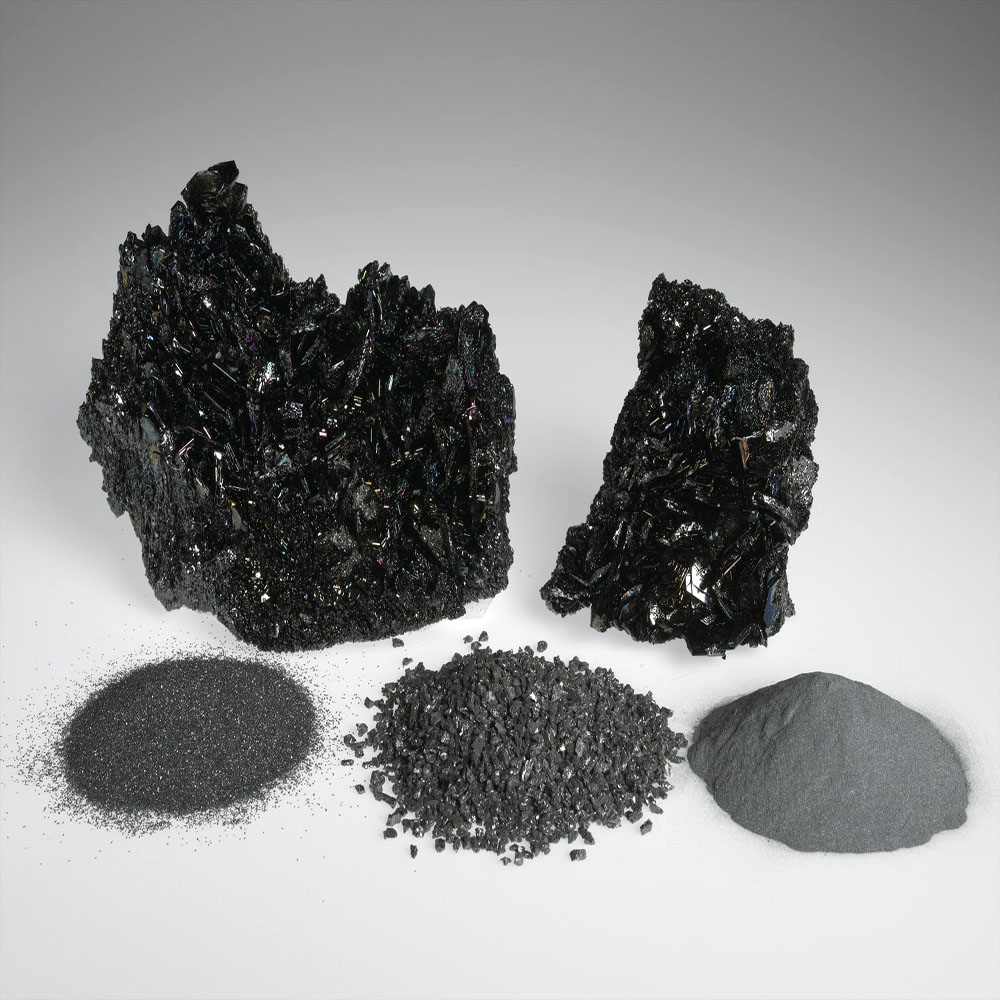
What are the black silicon carbide usages?
Black silicon carbide (SiC) is the “work-horse” abrasive grade (α-SiC, > 98 % SiC, low SiO₂/Fe). Because it is the hardest man-made mineral except diamond (Mohs 9.2–9.4, Knoop 2480) and yet costs only a few dollars per kilogram, it is consumed in very large volumes for jobs that simply need cheap, fast cutting and where the dark colour or slight friability is not a problem. The main uses are:
1. Bonded abrasives
– vitrified & resin grinding wheels for steel, cast iron, non-ferrous and carbide tools
– segments, mounted points, honing sticks for crank-shafts, gears, hydraulic spools
2. Coated abrasives
– wet-and-dry sandpaper, emery cloth, belts, discs, flap wheels for automotive body-work, wood, plastics, composites, marble
3. Loose-grain / pressure blasting
– grit blasting of ship hulls, steel plate, stone, concrete, aluminium castings (gives a sharp, matte anchor profile)
– glass etching, monument lettering, denim “stone-washing” (replaces pumice)
4. Mass-finishing / tumbling
– vibratory bowls for deburring aluminium die-castings, brass plumbing parts, stainless fasteners (cuts 2–3× faster than Al₂O₃)
5. Abrasive water-jet cutting
– 60–120 mesh SiC is the cheapest hard filler for cutting glass, rubber, marble, where garnet is too costly
6. Anti-thermal additives
– loose SiC slurry (F400–F1200) still used to slice marble blocks and some solar silicon ingots (being replaced by diamond but still > 30 kt yr⁻¹)
7. Refractory & metallurgical
– tap-hole clay, trough mass, ramming mix for cupola and iron foundry runners (high thermal conductivity, low wettability by Fe)
– SiC bricks for kiln furniture, zinc-distillation retorts, aluminium-melting crucibles (black SiC is cheaper than green SiC for non-abrasive refractory)
8. Wear & friction parts (low-end)
– brake-pad filler, clutch facings (gives green fade resistance and raises μ)
– inexpensive ceramic wear tiles for chutes, slurry hose inner liners (epoxy-bonded SiC grit)
9. Lapidary & glass art
– tumbler grit for agates, quartz, obsidian; glass cold-working (80–220 mesh)
10. Chemical / metallurgical additive
– 1–3 mm SiC added to cupola charge as carburiser/siliconiser and to improve melt fluidity
– precursor for Acheson process to make metallurgical-grade silicon (SiC + Fe → FeSi)
In short, black silicon carbide is used wherever you need aggressive, low-cost cutting or grinding on metals, stone, glass, composites or concrete, and as a cheap, heat-resistant additive in foundry and refractory systems.