

The differences between amorphous boron powder and crystalline boron powder
Both amorphous boron powder and crystalline boron powder are high-purity elemental boron materials. However, they differ significantly in terms of crystal structure, production process, chemical reactivity, and applications. The primary differences are as follows:
1. Crystal Structure
Amorphous Boron powder: Consists of approximately 60% α-rhombohedral boron and 40% non-crystalline (disordered) boron; it exhibits high chemical reactivity.
Crystalline Boron powder: Primarily β-rhombohedral boron, characterized by an ordered arrangement of icosahedral units; it is structurally stable and highly chemically inert.
2. Appearance
Amorphous Boron: A fine, brownish-black or dark-brown powder.
Crystalline Boron: Shiny black with a faint metallic luster fration & granules. particles feature distinct, sharp edges. Crystalline boron powder is available.
3. Reactivity
Amorphous Boron: Highly reactive with a low activation temperature for sintering. During the sintering process, it readily reacts at the silicon-silver interface. It acts as a p-type dopant and sintering aid, reducing the contact resistance between silver and silicon to form a high-quality ohmic contact—which is precisely why it is the specified material for photovoltaic (PV) silver pastes (such as the 2N 99% boron powder you are using).
Crystalline Boron: Highly chemically inert with a high reaction threshold. It requires significantly higher temperatures to participate in interfacial reactions, making it ineffective as a dopant within the standard sintering window used for silver pastes; therefore, it is unsuitable for solar silver pastes.
4. Hardness and Stability
Amorphous Boron: Relatively lower hardness; stable at room temperature but prone to oxidation at high temperatures.
Crystalline Boron: Has a Mohs hardness of approximately 9.5. It is extremely hard, resistant to high temperatures and oxidation, and withstands corrosion from acids and bases. Consequently, processing crystalline boron into fine powder is exceptionally difficult.
5. Production and Purity
Amorphous Boron: Produced via methods such as magnesiothermic reduction or the hydrogen reduction of boron halides. It is typically available at 95%–99% (2N) purity and is primarily supplied as an ultrafine powder. Crystalline boron: Produced via high-temperature crystallization, it is easier to achieve high purity levels (4N/5N/6N) and typically features larger grain sizes.
6. Applications
Amorphous boron (2N, 99%): Used in photovoltaic silver pastes, silver-aluminum pastes, electronic pastes, solid propellants, metallurgical deoxidation, and as a sintering aid.
Crystalline boron: Used in ultra-hard ceramics, the synthesis of borides, materials for the nuclear industry, neutron absorption and shielding, high-temperature and corrosion-resistant components, and as a dopant for semiconductor single crystals.
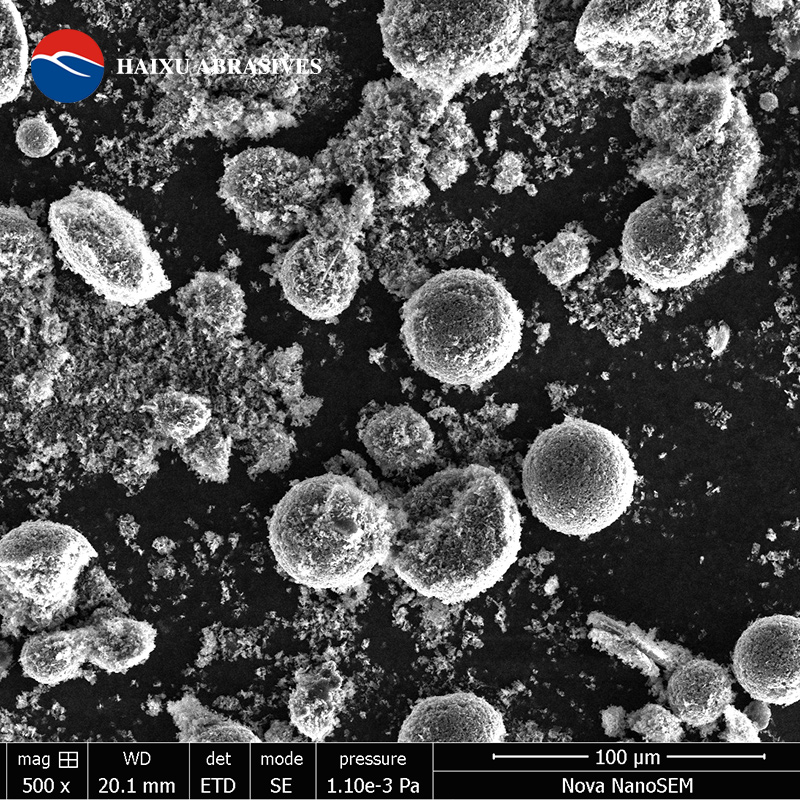
<Amorphous boron powder SEM graphic>
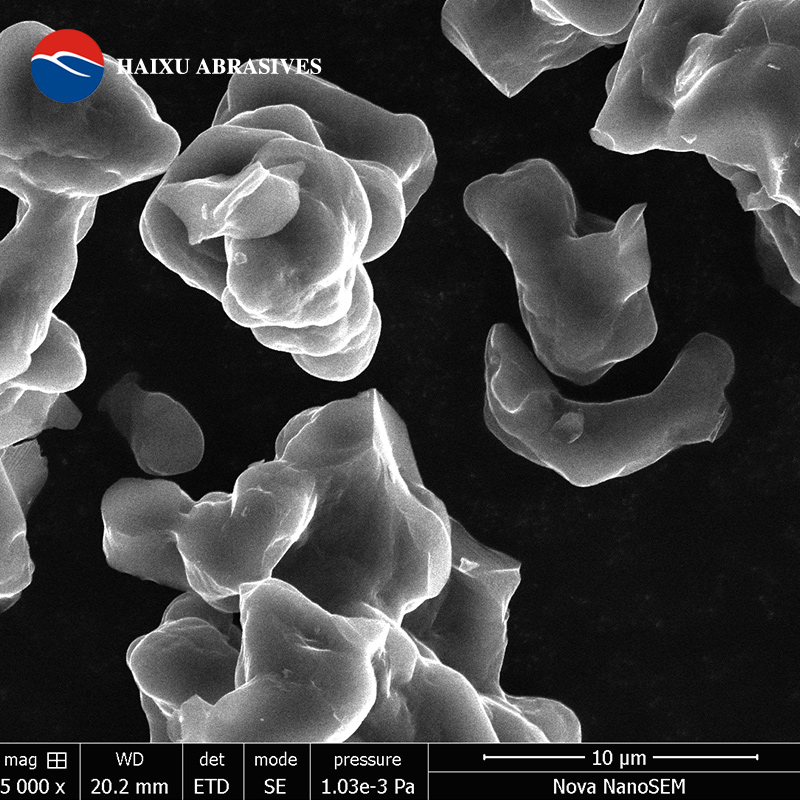
<crystalline boron powder SEM graphic>