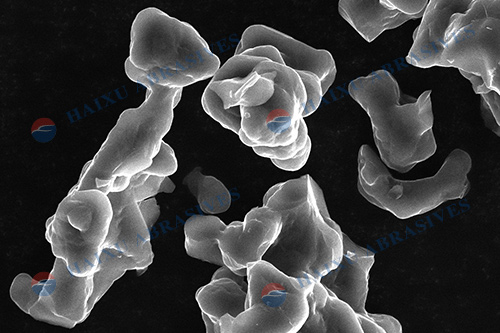
What is the crystalline phase of high-purity boron powder?
High-purity boron powder is categorized into two types: amorphous boron powder and crystalline boron powder. Amorphous boron lacks a long-range periodic crystalline phase. For semiconductor-grade crystalline boron (such as 6N-purity crystalline boron granules), the predominant crystalline phase is β-rhombohedral boron (β-B₁₀₆).
1. Amorphous Boron Powder
Crystalline Phase: Non-crystalline (amorphous); it possesses no defined crystalline phase.
Microstructure: While B₁₂ icosahedral structural units exist locally (short-range order), there is no periodic, long-range ordered lattice arrangement between these units. The atoms are arranged randomly, forming a disordered network. In X-ray diffraction (XRD) patterns, this manifests as broad, diffuse “humps” rather than sharp, characteristic diffraction peaks.
Amorphous boron is a metastable structure rather than a distinct crystalline polymorph. Upon high-temperature annealing (typically >1000°C in an inert atmosphere), it gradually transforms into the stable β-rhombohedral boron phase. Commercially available brownish-colored amorphous boron powder falls into this category; it exhibits high reactivity, is prone to oxidation, and tends to accumulate impurities at structural defects. Some simulation studies suggest that its short-range structure may contain local clusters resembling those found in α-rhombohedral boron; however, on a macroscopic scale, it is still classified as amorphous and cannot be termed “α-phase crystalline boron.” In the amorphous boron powder produced by our company, 60% of the material consists of α-phase elemental boron, while the remainder comprises a mixture of boron with indeterminate crystalline phases.
2. Crystalline Boron Powder/Granules (6N purity, 4–25 or 4–40 mesh, used for semiconductor doping)
The high-purity crystalline boron powder suitable for industrial applications—particularly in the semiconductor sector—is β-rhombohedral boron.
β-rhombohedral boron: Its unit cell contains 106 boron atoms, structured as a complex arrangement of numerous B₁₂ icosahedra linked by bridging boron atoms. It is the most thermodynamically stable phase across all temperature ranges at atmospheric pressure and exhibits a distinct set of sharp diffraction peaks in X-ray diffraction (XRD) analysis. It serves as the standard crystalline phase for boron used in semiconductor doping.
3. Differences in Semiconductor Doping Based on Crystalline Phase
β-rhombohedral crystalline boron: Features an ordered lattice with few defects; it exhibits low oxidation/volatilization rates in high-temperature molten silicon environments, ensuring high reproducibility in doping and stable resistivity.
Amorphous boron: Contains a large number of structural dangling bonds and defects; it is more prone to adsorbing oxygen and carbon impurities. Furthermore, it displays higher chemical reactivity within a single-crystal growth furnace, which can easily lead to resistivity drift and a reduction in minority carrier lifetime.