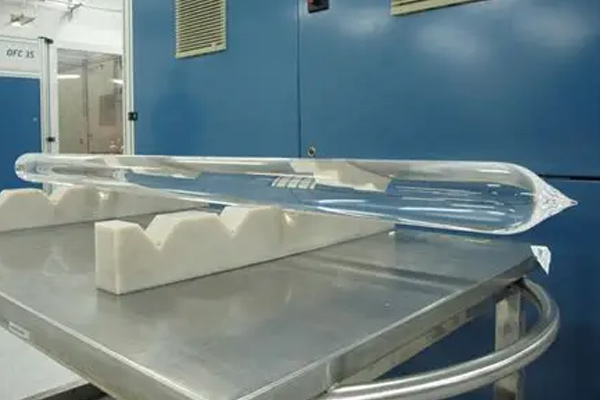
Green SiC powder GC1200# for polishing optical fiber preforms
Optical fiber preforms are optical fiber communication materials made of high-purity quartz glass. Due to its unique physicochemical properties, Green SiC powder GC1200# offers significant advantages in the polishing process of optical fiber preforms. The following is a detailed analysis of its core advantages:
1. High Hardness and High Cutting Efficiency
– High Hardness: Green silicon carbide abrasive powder has a Mohs hardness of approximately 9.5, second only to diamond and boron carbide, and far higher than quartz glass (Mohs hardness approximately 7). This allows it to efficiently remove microscopic cracks, scratches, and deformation layers from the preform surface during polishing.
– Uniform Particle Size: The particle size range corresponding to 1200# (approximately 3.5-5 micrometers) is suitable for the fine polishing stage, ensuring material removal rate while avoiding surface damage caused by excessive cutting.
2. Excellent Thermal Stability and Chemical Inertness
– High Temperature Resistance: Green silicon carbide remains stable at high temperatures (>1500℃) and will not decompose or deteriorate due to localized high temperatures generated by polishing friction, avoiding contamination of the preform surface.
– Chemical Inertness: It does not chemically react with the optical fiber preform (SiO₂), thus preventing the formation of surface residues (such as oxides and metal ions), ensuring high purity and low defect density after polishing.
3. Obtaining a Smooth and Low-Damage Surface
– Fracture Characteristics: Green silicon carbide fractures along cleavage planes during polishing, continuously generating new sharp cutting edges, maintaining cutting ability while reducing impact damage to the surface, helping to eliminate subsurface defects.
– Surface Roughness Optimization: GC1200 mesh powder can achieve nanoscale surface roughness (Ra < 0.5 nm), significantly reducing light scattering loss. This is crucial for optical fiber preforms, as their surface quality directly affects the optical performance of subsequent fiber drawing.
4. Controllable Slurry Dispersion and Compatibility
– Suspension Stability: Green silicon carbide polishing powder is easily and uniformly dispersed in water-based or oil-based polishing slurries. With appropriate dispersants (such as polyethylene glycol), agglomeration can be prevented, ensuring a stable and controllable polishing process.
– Strong Compatibility: It is compatible with various polishing pads (such as polyurethane and synthetic fibers) and requires no special pH adjustment or additives, reducing process complexity and cost.
5. Economic Efficiency
– High Cost-Effectiveness: Compared to diamond micropowder (which costs 10-100 times more), green silicon carbide significantly reduces consumable costs while meeting precision polishing requirements.